Definition of ripeness groups and their features
Corn is one of the world's main cereals, so to systematize and classify the data, FAO has developed a model according to which all corn varieties and hybrids are divided into nine main groups with designations ranging from 100 to 999. In numerical terms, hundreds determine the hybrid's belonging to a maturity group, and tens determine its position in the group. Within a group, hybrids differ slightly in terms of the growing season.
According to research, the difference between hybrids by 0.1% of dry weight at the beginning corresponds to one unit in FAO points in central Europe. A gradation of 10 FAO points corresponds to a 1-2 day difference in the period of reaching maturity under identical conditions, or a 1-2% difference in dry matter content for the same harvesting period.
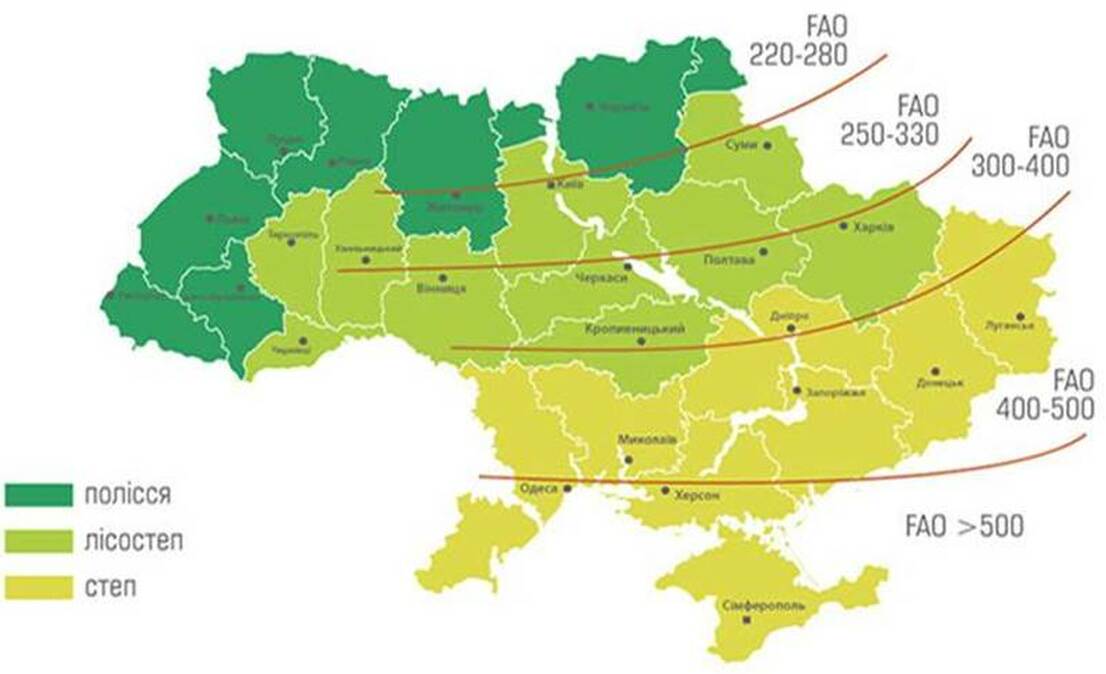
It is this classification that has become universal in the global definition of corn maturity groups. Belonging to the FAO maturity group makes it possible to conditionally identify a hybrid in any country in the world and determine its suitability for cultivation in a particular region for its intended purpose, i.e. the producer understands whether there will be a sufficient warm period in his region before the onset of technical maturity.
Classification of corn hybrids by FAO
| Heat requirements | Ripeness groups | ||||||
very early ripe | early ripe | medium-early | medium-ripe | medium-late | late-ripening | very late-ripening | |
Sum of active temperatures, ◦ С | 2050-2100 | 2200 | 2400 | 2600 | 2800 | 3000 | ≥3000 |
Sum of effective temperatures, ◦ С | 850-900 | 900-1000 | 1100 | 1150 | 1200 | 1300 | ≥1350 |
Sum of temperatures from germination to panicle ejection, ◦ С | 350 | 400 | 450 | 500 | 550 | 600 | ≥650 |
Sum of temperatures from panicle ejection to waxy ripeness, ◦ С | 350 | 400 | 450 | 500 | 550 | 600 | ≥650 |
Vegetation period, days | 80-90 | 90-105 | 105-115 | 115-120 | 120-130 | 135-140 | ≥150 |
Number of leaves per plant, pcs. | 12 | 12-14 | 14-16 | 17-18 | 19-20 | 21-23 | ≥23 |
Maturity group according to FAO classification | 100-149 | 150-199 | 200-299 | 300-399 | 400-499 | 500-599 | ≥600 |
Choosing a corn hybrid
However, the systematization into maturity groups according to the FAO classification should not be considered as a universal lever for maximizing corn yields. This classification is relative and the number of growing season days can vary in different regions depending on the ratio of warm and cold days and nights, the nature of temperature distribution during the growing season, the intensity of solar insolation, precipitation and the availability of nutrients in the field, competition from weeds, depth of basic tillage, particle size distribution, soil acidity, water and air permeability of the root layer, timing and density of sowing of a particular hybrid, germination and plant growth energy, etc. д.
In addition, there is an assessment of corn hybrids by the maturity index, which is also a rather conditional and indirect indicator that varies significantly with biotic and abiotic factors.
Therefore, the producer needs to take an integrated approach to choosing the right hybrid for him, taking into account, as the main one, the FAO classification of maturity groups, which make it possible to determine with high probability the suitability of the hybrid for cultivation in a given farm.



 Choose a country